
Growth in Demand for Natural Food Additives and Increasing Consumer Awareness About Clean Label Products

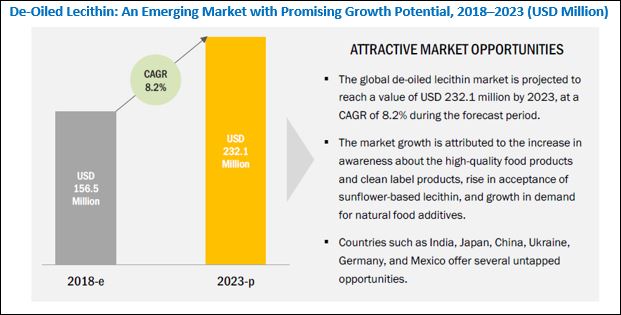
Global de-oiled lecithin market is projected to grow to reach a value of USD 232.1 million by 2023, at a CAGR of 8.2% from 2018.
De-oiled Lecithin Market

For More details on this research, Request Free Sample Report

The years considered for the study are as follows:

  • Base year: 2017
  • Forecast period: 2018–2023

Objectives of the study are as follows:

  • Market Intelligence
    • Determining and projecting the size of the de-oiled lecithin market with respect to the source, application, and regional presence, over a five-year period ranging from 2018 to 2023
    • Identifying attractive opportunities in the market by determining the largest and fastest-growing segments across regions
    • Analyzing the demand-side factors on the basis of the following:
      • Impact of macro- and micro-economic factors on the market
      • Shifts in demand patterns across different sub-segments and regions
  • Competitive Intelligence
    • Identifying and profiling key market players in the de-oiled lecithin market
    • Providing a comparative analysis of the market leaders on the basis of the following:
      • Product offerings
      • Business strategies
      • Strengths and weaknesses
      • Key financials
    • Understanding the competitive landscape and identifying major growth strategies adopted by the players across the key regions
    • Analyzing the regulatory frameworks across regions and their impact on the prominent market players
    • Providing insights on key investments in product innovations and technology

Research Methodology

This report includes estimations of the market size in terms of value (USD million) and volume (tons). Both, top-down and bottom-up approaches have been used to estimate and validate the size of the de-oiled lecithin market and of various other dependent submarkets in the overall market. Key players in the market have been identified through secondary research, and their market shares in the respective regions have been determined through primary and secondary research. All percentage shares, splits, and breakdowns have been determined using secondary sources National Soybean Processors Association (NSPA), the United States Department of Agriculture (USDA), the Food and Drug Administration (FDA), The Soybean Processors Association of India, American Soybean Association (ASA), United Soybean Board (USB), Brazilian Association of Vegetable Oil Industries (ABIOVE), Canadian Oilseed Processors Association (COPA) and National Oilseed Processors Association (NOPA) to identify and collect information useful for this technical, market-oriented, and commercial study of the de-oiled lecithin market.
Market for Food Diagnostics to Experience Significant Growth as Testing Increases for Food Pathogen

The food pathogen testing market was estimated to be valued at USD 7.42 Billion in 2015. The market is projected to grow at a CAGR of 7.8% during the forecast period. The increase in outbreaks of foodborne illnesses, and stringent safety & quality regulations for food are the factors driving this market.

The years considered for the study are as follows:

  • Base year – 2014
  • Estimated year – 2015
  • Projected year – 2020
  • Forecast period – 2015 to 2020

The objectives of the report

  • To define, segment, and project the global market size for food pathogen testing
  • To define, segment, and forecast the size of the food pathogen testing market with respect to type, food type, technology, and region
  • To analyze the market structure by identifying various subsegments of the global food pathogen testing market
  • To provide detailed information about the crucial factors that are influencing the growth of the market (drivers, restraints, opportunities, and challenges)
  • To analyze opportunities in the market for stakeholders and provide details of a competitive landscape for market leaders
  • To forecast the size of the global food pathogen testing market and its various submarkets with respect to four main regions, namely, North America, Asia-Pacific, Europe, and the Rest of the World (RoW) along with their respective key countries
  • To strategically profile the key players and comprehensively analyze their core competencies
  • To analyze competitive developments such as new service launches, mergers & acquisitions, expansions & investments, partnerships, agreements, joint ventures, and collaborations in the food pathogen testing market

Research Methodology:

  • Major regions were identified, along with countries contributing the maximum share
  • Secondary research was conducted to find the value of food pathogen testing for regions such as North America, Europe, Asia-Pacific, and RoW
  • The key players have been identified through secondary sources such as the Food & Drug Administration (FDA), the United States Department of Agriculture (USDA), and the Canadian Food Inspection Agency (CFIA), while their market share in respective regions has been determined through both, primary and secondary research. The research methodology includes the study of annual and financial reports of top market players, as well as interviews with industry experts (such as CEOs, VPs, directors, and marketing executives) for key insights (both quantitative and qualitative) in the food pathogen testing market.
  • The various contributors involved in the value chain of the food pathogen testing market include R&D institutes, food pathogen testing service providing companies as SGS, Bureau Veritas, Intertek, Eurofins, pathogen testing equipment manufacturing companies, and government bodies & regulatory associations such as the United States Department of Agriculture (USDA), the Food and Drug Administration (FDA), and the European Food Safety Authority (EFSA).

Rice Protein Can Meet the Needs of Consumers Looking for Non-Allergen, Lactose-Free, and Gluten-Free Source of Protein

The oryzenin market stood at USD 79.36 million in 2015; it is projected to grow at a CAGR of 14.5% from 2016, to reach USD 198.25 million by 2022. The base year considered for the study is 2015 and the forecast period is from 2016 to 2022. The main objective of the report is to define, segment, and project the global market size for oryzenin on the basis of type, application, form, and region. It also helps to understand the structure of the oryzenin market by identifying its various segments. The other objectives include analyzing the opportunities in the market for stakeholders and providing a competitive landscape of market trends, analyzing the macro- and micro-indicators of this market, and projecting the size of the oryzenin market and its submarkets, in terms of value as well as volume.

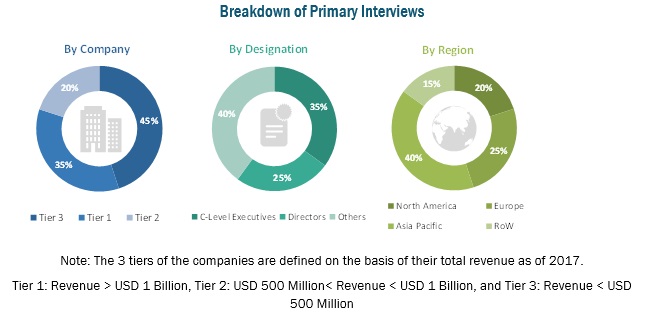
This report includes estimations of the market size in terms of value (USD million) and volume (tons). Both, the top-down and bottom-up approaches have been used to estimate and validate the size of the oryzenin market and to estimate the size of various other dependent submarkets in the overall market. The key players in the market have been identified through secondary research; some of these sources are press releases, paid databases such as Factiva and Bloomberg, annual reports, and financial journals; their market shares in respective regions have also been determined through primary and secondary research. All percentage shares, splits, and breakdowns have been determined using secondary sources and verified through primary sources. The figure below shows the breakdown of profiles of industry experts that participated in the primary discussions.

To know about the assumptions considered for the study, download the pdf brochure

Key participants in the oryzenin market are manufacturers, oryzenin manufacturers, distributors & suppliers, associations and industry bodies, and end users. The key players profiled include Axiom Foods, Inc. (US), AIDP Inc. (US), RiceBran Technologies (US), Kerry Group plc (Ireland), and BENEO GmbH (Germany). The other players of the oryzenin market are Ribus, Inc. (US), Green Labs LLC (US), Golden Grain Group Limited (China), Shaanxi Fuheng (FH) Biotechnology Co., Ltd. (China), and Bioway (Xi’an) Organic Ingredients Co., Ltd. (China).

This report is targeted at the existing stakeholders in the industry, which include the following:

  • Supply side: Oryzenin manufacturers, suppliers, formulators, traders, distributors, and suppliers
  • Demand side: Plant protein manufacturers, food processing industries, whey producers, large sports drink manufacturing companies, and researchers
  • Regulatory side: Organizations such as the Food and Drug Administration (FDA), European Food Safety Authority (EFSA), United States Department of Agriculture (USDA), and Food Standards Australia New Zealand (FSANZ)

“The study answers several questions for stakeholders, primarily which market segments to focus on in the next two to five years for prioritizing efforts and investments.”

Termite Bait Systems Market -Effects are Relatively Slow as Compared to Liquid Chemical Barriers

Termite Bait Systems Market categorizes the global market by Application (Commercial & Industrial, Residential, Agriculture & Livestock Farms), Termite Type (Subterranean, Dampwood, Drywood), Station Type (In-Ground, Above-Ground), and Region. The termite bait systems market is estimated at USD 260.8 million in 2018 and is projected to reach USD 342.5 million by 2023, at a CAGR of 5.60% during the forecast period.

The years considered for the study are as follows:

  • Base year – 2017
  • Estimated year – 2018
  • Projected year – 2023
  • Forecast period – 2018 to 2023

Objectives of the report

  • Determining and projecting the size of the termite bait systems market with respect to termite type, station type, application, and regional markets, over a five-year period ranging from 2018 to 2023
  • Identifying attractive opportunities in the market by determining the largest and fastest-growing segments across regions
  • Analyzing the demand-side factors on the basis of the impact of macro- and micro-economic factors on the market and shifts in demand patterns across different subsegments and regions

Research Methodology:

  • Major regions were identified, along with countries contributing the maximum share
  • Secondary research was conducted to obtain the value of termite bait systems market for regions such as North America, Europe, Asia Pacific, South America, and RoW
  • The key players have been identified through secondary sources such as Bloomberg, Factiva, agricultural magazines, and companies’ annual reports while their market share in the respective regions has been determined through both, primary and secondary research. The research methodology includes the study of annual and financial reports of top market players as well as interviews with industry experts (such as CEOs, VPs, directors, and marketing executives) for key insights (both quantitative and qualitative) for the termite bait systems market.

Food & Beverage Disinfection Market-Growing Awareness About Food Safety Among Consumers

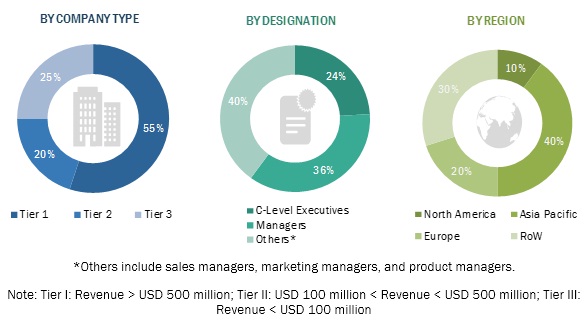
This report includes estimations of the market size in terms of value (USD million). Both, top-down and bottom-up approaches have been used to estimate and validate the size of the global food & beverage disinfection market and to estimate the size of various other dependent submarkets in the overall market. The key players in the market have been identified through secondary research, some of the sources are press releases, paid databases such as Factiva and Bloomberg, annual reports, and financial journals; their market share in respective regions have also been determined through primary and secondary research. All percentage shares, splits, and breakdowns have been determined using secondary sources and were verified through primary sources. The figure below shows the breakdown of profiles of industry experts that participated in the primary discussions. Food & Beverage Disinfection Market categorizes the global market by Type (Chemical (Chlorine, Hydrogen Peroxide & Peracetic Acid, and Ammonium), Technology (UV Radiation, Ozonation)), End Use, Application (Surface, Packaging, Processing Equipment), and Region. The food & beverage disinfection market was valued at USD 144.5 million in 2017; this is projected to reach a value of USD 178.2 million by 2023, growing at a CAGR of 3.7% from 2018. The basic objective of the report is to define, segment, and project the global market size for food & beverage disinfection technology and disinfectant chemicals on the basis of end use, application areas, type, and region. It also helps to understand the structure of the food & beverage disinfection market by identifying its various segments. The other objectives include analyzing the opportunities in the market for stakeholders and providing a competitive landscape of market trends, and to project the size of the food & beverage disinfection market.

This report is Targeted at the existing players in the industry, which include the following:

  • Regulatory and research organizations
  • Food & beverage disinfection technology and disinfectant chemicals producers, suppliers, and distributors
  • Equipment manufacturers, traders, distributors, and dealers

“The study answers several questions for stakeholders, primarily which market segments to focus on in the next two to five years for prioritizing efforts and investments.”

Scope of the food & beverage disinfection market report

On the basis of Type, the food & beverage disinfection market has been segmented as follows:

  • Chemical
    • Chlorine compounds
    • Hydrogen peroxide & peracetic acid
    • Quaternary ammonium compounds
    • Alcohols
    • Others*
  • Technology
    • UV radiation
    • Ozonation
    • Others**

*Others include idophors and aldehydes.
**Others include dry fogging and steam-ultrasound.

On the basis of Application areas, the food & beverage disinfection market has been segmented as follows:

  • Food surface
  • Food packaging
  • Food processing equipment

Multifunctionality of Beverage Stabilizers Leads to Their Wide Applications

Beverage Stabilizers Market report categorizes the Global Market by Application (Fruit Drinks, Dairy Products, and Soft Drinks), Type (Xanthan Gum, Carrageenan, Gum Arabic, and CMC), Function (Stabilization, Texturization, and Viscosification), and Region. The global beverage stabilizers market was valued at USD 110.9 million in 2017 and is projected to reach USD 153.8 million by 2023, at a CAGR of 5.6% from 2018. The key drivers for the market’s growth are the rise in beverage consumption, the multi-functionality of beverage stabilizers, and the increase in the use of natural ingredients in foods due to increasing consumer awareness about healthy diets. However, adherence to international quality standards and regulations for beverage additives such as stabilizers and the fluctuation of raw material prices act as restraints for the market’s growth. Innovation in technology and emerging applications using customized stabilizer blends are significant growth opportunities for the market.

Objectives of the study are as follows:

  • To define, segment, and measure the beverage stabilizers market with respect to its type, application, function, and region
  • To provide detailed information about the major factors influencing the growth of the market (drivers, restraints, opportunities, and industry-specific challenges)
  • To analyze the complete value chain and supply chain of beverage stabilizers
  • To analyze the opportunities in the market for stakeholders and provide details of the competitive landscape for market leaders
  • To profile the key players and comprehensively analyze their core competencies
  • To analyze the competitive developments-new product developments, mergers & acquisitions, investments, expansions, joint ventures, collaborations, and supply contracts-in the beverage stabilizers market
  • To profile the key beverage stabilizers companies with respect to the business overview, recent financials, segmental revenue mix, geographic presence, and information about the products & services

Research Methodology

This report includes estimations of the market size in terms of value (USD million) and volume (KT). The top-down and bottom-up approaches have been used to estimate and validate the size of the beverage stabilizers market and to estimate the size of various other dependent submarkets in the overall market. The key players in the market have been identified through secondary research; some of these sources are press releases, paid databases such as Factiva and Bloomberg, annual reports, and financial journals, ICBA (International Council of Beverage Associations), Food and Agricultural Organization (FAO), American Beverage Association (ABA), and Global Food & Beverage Association (GFBA); their market share in respective regions have also been determined through primary and secondary research processes. All percentage shares, splits, and breakdowns have been determined using secondary sources and verified through primary sources. The figure below shows the breakdown of profiles of industry experts that participated in primary discussions.

India is Projected to Be the Fastest-Growing Market for Vitamins Between 2018 and 2023

The vitamins market was valued at USD 4.85 billion in 2017; it is projected to reach USD 7.35 billion by 2023, at a CAGR of 7.3% during the forecast period. The growth in the demand for functional and nutritionally enriched processed food products, the prevalence of vitamin deficiencies, and feed fortification due to rise in global meat & dairy product consumption are factors driving this market.

Objectives of the report

  • Determining and projecting the size of the vitamins market on the basis of  type, source, application, and regional presence, over a five-year period, ranging from 2018 to 2023
  • Identifying attractive opportunities in the market by determining the largest and fastest-growing segments across regions
  • Analyzing the demand-side factors on the basis of the following:
    • Impact of macro- and microeconomic factors on the market
    • Shifts in demand patterns across different subsegments and regions
  • Identifying and profiling key players and product providers in the vitamins market
  • Providing a comparative analysis of market leaders on the basis of the following:
    • Product offerings
    • Business strategies
    • Strengths, weaknesses, opportunities, and threats
    • Key financials
  • Understanding the competitive landscape and identifying major growth strategies adopted by players across key regions
  • Providing insights on key investments in product innovation and technology

Research Methodology:

  • Key regions were identified along with countries contributing to the maximum share.
  • Secondary research was conducted to find the value of the vitamins market for regions such as Europe, North America, Asia Pacific, and RoW.
  • The key players were identified through secondary sources such as the Food and Agriculture Organization (FAO), the US Department of Agriculture (USDA), the International Monetary Fund (IMF), the World Bank, and the Organisation for Economic Co-operation and Development (OECD); while their market shares in their respective regions were determined through both primary and secondary research processes. The research methodology included the study of annual and financial reports of top market players, as well as interviews with industry experts (such as CEOs, VPs, directors, and marketing executives) to obtain key insights (both quantitative and qualitative) for the vitamins market.The various contributors involved in the value chain of the vitamins market include raw material suppliers, R&D institutes, vitamins manufacturers [Koninklijke DSM N.V. (Netherlands), BASF (Germany), Lonza Group (Switzerland), Glanbia plc (Ireland), and ADM (US)], manufactures for end-use products (food & beverage, healthcare, feed, and personal care products) and government bodies & regulatory associations [the US Department of Agriculture (USDA), the Food and Drug Administration (FDA), and the European Food Safety Authority (EFSA)]. 

Seaweed Farming – An Alternative Livelihood Boosted By Economic Opportunities and Rising Global Demand

The commercial seaweeds market was valued at USD 13.07 billion in 2017 and is projected to reach USD 21.11 billion by 2023, at a CAGR of 8.4% from 2018, in terms of value. The objective of this study is to define, segment, and project the size of the commercial seaweeds market based on types, forms, methods of harvesting, applications, and regional presence, over a five-year period ranging from 2018 to 2023.

Objectives of the study are as follows:

  • Identifying attractive opportunities in the market by determining the largest and fastest-growing segments across regions
  • Analyzing the demand-side factors on the basis of the following:
    • Impact of macroeconomic and microeconomic factors on the market
    • Shift in demand patterns across different subsegments and regions
  • Identifying and profiling key players and manufacturers in the commercial seaweeds market
  • Providing a comparative analysis of market leaders on the basis of the following:
    • Product offerings
    • Business strategies
    • Strengths, weaknesses, opportunities, and threats
    • Key financials
  • Understanding the competitive landscape and identifying major growth strategies adopted by players across key regions
  • Providing insights on key investments in product innovation and application

The years and periodization considered for the study are as follows:

  • Base year: 2017
  • Beginning of the projection period: 2018
  • End of the projection period: 2023

This report includes the estimation of the market size for value (USD million). Both, top-down and bottom-up approaches were used to estimate and validate the size of the commercial seaweeds market and to estimate the size of various other dependent submarkets. Key players in the market were identified through secondary research (FAO, Bloomberg Businessweek, and companies’ annual reports). All percentage shares, splits, and breakdowns were determined using secondary sources and verified through primary sources.

Market Ecosystem

The contributors involved in the value chain of commercial seaweeds include manufacturers, suppliers, distributors, importers, and exporters. The key players in the commercial seaweeds market include DowDuPont (US), Cargill (US), Roullier Group (France), COMPO EXPERT (Germany), Biostadt India (India), CP Kelco (US), BRANDT (US), Acadian Seaplants (Canada), Gelymar (Chile), Seasol international (Australia), Algea (Norway), Algaia (France), CEAMSA (Spain), and Seawin biotech (China).

Target Audience

  • Commercial seaweeds manufacturers
  • Commercial seaweeds importers and exporters
  • Commercial seaweeds traders, distributors, and suppliers
  • Food products manufacturers, processors, distributors, and traders
  • Feed manufacturers, processors, distributors, and traders
  • Agricultural fertilizers manufacturers, processors, distributors, and traders
  • Manufacturers, processors, distributors, and traders of other applications, such as cosmetics and pharmaceuticals

Rain-Fast Characteristic—An Important Attribute for the Increasing Demand for Molluscicides

The molluscicides market was valued at USD 563.7 million in 2017; it is projected to grow at a CAGR of 4.4%, to reach USD 727.8 million by 2023. The basic objective of the report is to define, segment, and project the global market size for molluscicides on the basis of application, type, form, and region. Other objectives include analyzing the opportunities in the market for stakeholders and providing a competitive landscape of market trends, analyzing the macro and microeconomic indicators of this market to provide factor analysis, and to project the growth rate of the molluscicides market. The base year considered for the study is 2017, while the forecast period considered is from 2018 to 2023.

This report includes estimations of the market size in terms of value (USD million). Both the top-down and bottom-up approaches have been used to estimate and validate the size of the global molluscicides market and to estimate the size of various other dependent submarkets. The key players in the market have been identified through secondary research; from sources such as press releases; paid databases such as Factiva and Bloomberg); annual reports; and financial journals; their market shares in their respective regions have also been determined through primary and secondary research. All percentage shares, splits, and breakdowns have been determined using secondary sources and were verified through primary sources. The figure below shows the breakdown of profiles of industry experts that participated in the primary discussions.

The key players that are profiled in the report include Lonza Group (Switzerland), Bayer Cropscience (Germany), American Vanguard Corporation (US), BASF (Germany), Adama Agricultural Solutions (Israel), Marrone Bio Innovations (US), De Sangosse (UK), Doff Portland (UK), Certis Europe (Netherlands), PI Industries (India), Syngenta (Switzerland), and Neudorff GmbH (Germany)

This report is targeted at the existing players in the industry, which include the following:

  • Regulatory and research organizations
  • Molluscicide  manufacturers, suppliers, distributors, and retailers
  • Pesticide producers, suppliers, distributors, and retailers
  • End product distributors, dealers, and farmers

“The study answers several questions for the stakeholders; primarily, which market segments to focus on in the next 2 to5 years for prioritizing efforts and investments.”

Molluscicides Market

To know about the assumptions considered for the study, download the pdf brochure

Scope of the Report

On the basis of type, the molluscicides market has been segmented as follows:

  • Chemical Molluscicide
    • Metaldehyde
    • Methiocarb
    • Ferrous phosphate
    • Others (ferric sodium EDTA and metal salts)
  • Biological Molluscicide

On the basis of application, the molluscicides market has been segmented as follows:

  • Agricultural
    • Fruits & vegetables
    • Cereals & grains
    • Oilseeds & pulses
  • Non-agricultural
    • Commercial
    • Residential

On the basis of form, the molluscicides market has been segmented as follows:

  • Pellets
  • Liquid & Gel

On the basis of region, the molluscicides market has been segmented as follows:

  • North America
  • Europe
  • Asia Pacific
  • RoW (Brazil, Argentina, and others)

Seaweed: A Sustainable Material to Replace Plastic Packaging

Feed packaging market is projected to grow from USD 13.8 billion in 2018 to USD 17.8 billion by 2023, at a Compound Annual Growth Rate (CAGR) of 5.2% during the forecast period. The study involved four major activities in estimating the current market size for the feed packaging market. Exhaustive secondary research was done to collect information on the market as well as the peer and parent markets. The next step was to validate these findings, assumptions, and sizing with industry experts across the value chain through primary research. Both the top-down and bottom-up approaches were employed to estimate the complete market size. Thereafter, market breakdown and data triangulation were used to estimate the market size of segments and subsegments.

Secondary Research

In the secondary research process, various sources were referred to, so as to identify and collect information for this study. These secondary sources included reports from the American Feed Industry Association (AFIA), European Feed Manufacturers’ Federation (FEFAC), and EU Association of Specialty Feed Ingredients and their Mixtures (FEFANA); annual reports; press releases & investor presentations of companies; white papers; certified publications; articles by recognized authors, packaging safety regulations, feed safety organizations, regulatory bodies, trade directories, and databases.

Secondary research was mainly used to obtain key information about the industry’s supply chain; the total pool of key players; market classification; and segmentation, according to industry trends to the bottom-most level; and regional markets. It was also used to obtain information about the key developments from a market-oriented perspective.

Primary Research

The overall feed packaging market comprises several stakeholders such as feed traders and distributors, pet food traders and distributors, animal feed and packaging regulatory bodies, manufacturers of feed packaging, manufacturers of pet food packaging, pet food packaging material distributors/suppliers, livestock feed packaging material distributors/suppliers, technology providers to feed packaging companies, environmental protection bodies, and regulatory bodies in the supply chain. The demand side of this market is characterized by the development of the feed industries, the rise in livestock population, and an increase in pet adoption and humanization. The supply side is characterized by advancements in technology. Various primary sources from both the supply and demand sides of the overall market were interviewed to obtain qualitative and quantitative information.

The primary interviewees from the demand side include key opinion leaders, executives, vice presidents, and CEOs of the livestock feed and pet food industries. The primary sources from the supply side include research institutions involved in R&D to introduce new feed packaging; key opinion leaders; distributors; and livestock feed & pet food packaging manufacturers.

Feed Packaging Market

To know about the assumptions considered for the study, download the pdf brochure

Market Size Estimation

Both the top-down and bottom-up approaches were used to estimate and validate the total size of the feed packaging market. These approaches were also used extensively to estimate the size of various subsegments in the market. The research methodology used to estimate the market size includes the following details:

  • The key players were identified through extensive secondary research.
  • The feed packaging industry’s value chain and market size in terms of value were determined through primary and secondary research.
  • All percentage shares, splits, and breakdowns were determined using secondary sources and verified through primary sources.
  • All the possible parameters that affect the market covered in this research study were accounted for, viewed in extensive detail, verified through primary research, and analyzed to obtain the final quantitative and qualitative data.